Shopping Online3

  • Subscribe to our RSS feed.
  • Twitter
  • StumbleUpon
  • Reddit
  • Facebook
  • Digg

Wednesday, 19 December 2012

Announcing the 2012 Top Contributor badge recipients

Posted on 10:00 by Unknown


2012 was quite eventful for the AdWords Top Contributors. The year started with moving to the new home for the Community, which became the online meeting place for small business owners and online marketing professionals. AdWords Top Contributors helped tens of thousands of businesses find ways to get the best results from AdWords and provided the Community with exclusive tips and tricks. In October 2012, some AdWords Top Contributors visited the Googleplex in California for the AdWords Communities Summit. During this two-day event, they had a chance to meet with AdWords support and product management teams, to learn from each other, and to provide feedback to Google’s teams.


We want to thank Top Contributors for their dedicated participation in the AdWords Community and for being the true advocates of online advertising. Our annual tradition is to recognize the most outstanding “above and beyond” efforts with the annual Top Contributors badge. The 2012 recipients for the annual AdWords Top Contributor badge (English) have just been announced! Drum-roll, and congratulations to:

  • Calin Sandici
  • Jon Gritton
  • Kim Clinkunbroomer*
  • Lakatos Bela
  • Moshe Avichai
  • Pankaj Sabharwal
  • Pete Bardo
  • Scott Dunroe
  • Theresa Zook
  • Tommy Sands


In addition to the listed Top Contributors from the English Community, the badge was also granted to 25 other Top Contributors from our international AdWords Communities in French, German, Italian, Polish, Portuguese, Russian and Spanish languages.

Congratulations! It’s time to enjoy the holidays, and look forward to a new exciting journey of 2013!

*Kim Clickunbroomer is now a Top Contributors alumni, but her contribution this year was and still is remarkable.

Post Posted by the AdWords Communities team
Read More
Posted in | No comments

Tuesday, 18 December 2012

More investments for powerful, flexible, and fast reporting in DoubleClick Search

Posted on 10:47 by Unknown
We recently introduced the availability of instant Floodlight conversion data for automatic, intra-day conversions in all DoubleClick Search reports, to bring you the freshest, most reliable campaign data. This is just one of the ways we’re doubling down in our reporting investments to help you make better decisions as the digital landscape grows broader and deeper across formats, devices and channels. Today, we’re excited to announce 4 new features that build on this by ensuring important business data is accessible and actionable within DoubleClick Search: our offline conversions API, Google Analytics data integrations, Formula Columns, and Web Query support.

With online advertising expanding across different ad formats, new devices, and multiple channels, it’s no surprise that reporting continues to be a challenge for marketers. In fact, 69% of business and technology leaders have pinpointed the inability to gather, understand, and act on all the data about their customers as a leading challenge. To answer this growing complexity, we at DoubleClick Search have been focusing on developing the right tools to power your business with all the insights you need. We want to make reporting on all your data easy, to help drive insights exactly when you want them, where you want them.

Event API for easy offline conversion integration

DoubleClick Search already lets you leverage a variety of solutions to report on conversions, including our proprietary Floodlight tag, AdWords conversion tracking, or Google Analytics goals. But we understand that online advertising also fuels offline conversions. To capture these lost conversions and bring offline into your online world, we’re announcing the open beta of our Event API for uploading offline conversion automatically. Upload new conversions to account for in-store transactions, call-tracking, or other offline activities, or edit existing conversions to account for discounts, returns, credit, or fraud through integrated API access. Today, you can combine this information with our Performance Bidding Suite to optimize your campaigns based on even more of your business data.

Google Analytics website data, with the rest of your search

Couple this with the integration of Google Analytics metrics, which incorporates statistics including bounce rate, page views, transactions, and revenue from Google Analytics, to get a clear picture of how search influences customer interaction on your website. These recent developments in reporting mean faster decision making with all your data holistically captured in DoubleClick Search -- all without mashing up and matching reports or worrying about the potential data drop off of reporting from separate tools. In the next few months, we’ll introduce the ability to use bid strategies with your website metrics, ensuring your campaign’s bid optimization is informed by important user engagement metrics.

Formula magic, directly in the interface
With this wealth of data at your fingertips, how do you more easily make sense of it all? In the past, you’d need to use a spreadsheet tool like Excel to create these calculated columns. Formula Columns lets you create your own customized columns, based on calculations that you apply to existing columns. Now, apply formulas directly in DS and streamline your workflow: track custom KPIs, re-express columns in your own terms, and calculate customized fees, costs, and weights, among other applications.

Web query for data, where you want it
And finally, when it comes to easily accessing all your important data right where you want it, we’re introducing Web query support: instead of scheduling or downloading a file to access your reports, DoubleClick Search now provides a URL that you can use to automatically download and refresh that report’s data -- directly in Excel. This makes it even easier for you to create common report templates in Excel and populate those with the latest DS data, removing the need to manually download and import reports.

Formula Columns, instant conversions, and Web Query support are are available now in DoubleClick Search. To learn more about the Event API or Google Analytics integration, please reach out to your Technical Account Manager, or our support team at ds-support@google.com.
Read More
Posted in DoubleClick for Advertisers, floodlight | No comments

Monday, 17 December 2012

AdWords Express holiday offer extended for a limited time

Posted on 13:00 by Unknown

Still scrambling to stay ahead of the holidays? We want to help you make the most of the last 2 weeks of the year, so we’re extending our offer to double your AdWords Express investment. Just start using AdWords Express to attract new customers to your U.S. business, and you'll get a free advertising credit in January worth what you spend on AdWords Express ads between now and December 31, 2012.*


Reaching potential customers online is a snap with AdWords Express. Just select your business category, write an ad, and set your budget. Where and when your ad appears is managed automatically, and you only pay when potential customers click on your ad for more information. And in mid-January, you’ll receive a free advertising credit for that amount you spent on AdWords Express ads in December.*

Get started today at http://www.google.com/adwords/express/.

Posted by Richard Holden, Product Management Director, AdWords Express

*Terms and conditions
Read More
Posted in AdWords Express | No comments

New column makes keyword management easier

Posted on 11:18 by Unknown
We recently launched a new keyword column in the search term report to let you see exactly which keywords matched particular search terms. With this information at your fingertips, you can quickly and easily make better keyword and bid management decisions. But don’t take our word for it. We’ll let Top Contributors Calin Sandici and Moshe Avichai from the AdWords Community explain why the column is an important part of a healthy AdWords diet.


What’s so special about this new column?

Calin: You can now see in one simple table which keyword matches which search terms, for all the keywords in an ad group, campaign, or even the whole account, and you can act accordingly. It's cool, it saves time, it’s zero calories and it’s good for your health.

Moshe: Finally, there’s no need to guess which keyword triggers an ad.


What were your first thoughts when you heard the column was available?

Calin: For the first time, I can stay within AdWords and decide whether I should delete or pause a keyword altogether, or keep it and use some negative keywords to block unwanted impressions for irrelevant search queries. In the past I had to resort to the Analytics API to achieve the same effect. That’s no longer the case, because we now have access to a lot more information right in the AdWords interface.

How does it change the search terms report?

Moshe: Now the report is much more transparent. A campaign manager can see, at one glance, the complete funnel that triggered an ad: the original search term a user was searching for, through the keyword that matched the search term, and finally the ad group of the ad shown, all on the same page.

Calin: You no longer have to guess which keyword matched which search terms if you’re looking at more than one keyword. Previously, you could select one keyword at a time, and see the search terms that it matched. Now you can look at a whole ad group, campaign or account, see all the search terms that have caused your ads to show during a certain period of time, and right next to them, which keyword is "responsible" for a particular search term.

And finally, what do you hope to see from AdWords reporting in the future?

Calin: It could be great if we could import the Google Analytics metrics in the Keywords tab into the search terms report. Even if a search term doesn’t convert directly, if it leads to visits where one can see a large number of pages per visit or a low bounce rate, it may prove useful. In the absence of those metrics, we can only judge the search queries in terms of conversions.

Moshe: I am a great fan of the 80/20 Pareto principle: “You can draw roughly 80% of the conclusions from 20% of the data.” I have as much data as I need to run effective campaigns. As Calin suggested,  a better integration of presenting data from both Analytics and Adwords in a “unified report” could be helpful.

Discuss the new column in the AdWords Community, or check out the search terms report article in the AdWords Help Center.

Posted by Cindy Meyers and Virginia Roman, Editors, Online Help
Read More
Posted in AdWords Community, Keywords, Reporting | No comments

Friday, 14 December 2012

Modcloth and Inflection Drive Performance with Next-Gen Keyword Contextual Targeting

Posted on 09:39 by Unknown
Advertisers use contextual targeting on the Google Display Network to reach new customers as they browse content related to their products and services. In March we launched Next-Gen Keyword Contextual Targeting, which enabled our display advertisers to manage their contextual campaigns with the same level of precision and granularity as search. In a few short months we’ve been delighted to see how it’s translated into real results for our customers, and today we’d like to shine a light on two specific examples.

Modcloth, an online retailer selling vintage inspired clothing, had been using contextual targeting on the Google Display Network as a way to scale their message across a wide variety of sites. Their challenge was figuring out which keywords were triggering which conversions across their multiple product lines. With keyword level reporting and optimization levers, Theresa Rockovich, Modcloth’s SEM Manager, was excited to finally put her SEM skills to work. “Before the ability to target and bid on keywords, we were barely making these campaigns profitable. Now that we’ve been able to adjust our bids and see which keywords are driving performance, margins are the healthiest they’ve ever been.” In nine weeks, their keyword-level optimizations helped turn three unprofitable contextual campaigns into some of their highest performers. Their jewelry lines saw a 460% increase in click-through-rates and their dresses campaign saw a 700% increase in ROI.

Andrew Wong, Marketing Director at Inflection, similarly took a search-focused approach to managing their contextual campaigns. “We took the shell of our search campaigns and copied them onto the Google Display Network” and created specific page URLs for each product line. After a few weeks of generating traffic, they turned on the Display Campaign Optimizer – the Google Display Network’s auto-optimization tool that automatically manages targeting and bidding – and the results were phenomenal. With the help of DCO, they increased conversions by 480% at a cost-per-action 10% lower than the rest of their display campaigns.


Keyword level targeting is one of the many reasons why our Display Campaign Optimizer  has improved in both accuracy and efficiency the past year. We've seen advertisers are usually able to reach their target cost-per-acquisition (CPA) in about two weeks, versus the two months it often took before these changes. Coupled with new bidding capabilities, such as real-time bidding, MaxCPC and Enhanced CPC, DCO is now available to use on ‘hybrid’ search and display campaigns.

And it gets even better
In addition to keyword targeting, bidding and reporting, today we’re announcing  new keyword status messages to assist advertisers troubleshoot for more effective and consistent keyword matching and delivery. Now you’ll know if a keyword is pointing to a suspended site, has been disapproved, or if it matches too few pages (Few Page Matches). We’ve also added a notification that alerts users with display-only campaigns when a Display Network bid - which overrides keyword bids when ads are shown on the Google Display Network - is in place. We recommend removing the Display Network Bid in display-only campaigns to take advantage of keyword level bidding. Click here to learn how.

Learn More
We look forward to seeing even more success stories as we continue to roll out these new features! To learn more about how to implement these strategies into your display campaigns, download the Google Display Network Guide here!

Posted by Katie Hamilton, Product Marketing Manager Google Display Network
Read More
Posted in Case studies, Display Network, Optimization, Targeting | No comments

Tuesday, 11 December 2012

Education and training opportunities this week

Posted on 15:59 by Unknown
With the holidays rapidly approaching, check out our lineup of educational opportunities this week to maximize your advertising effectiveness through the end of the year:
  • Grab your eggnog for the last Learn with Google webinar of the season. On Wednesday, December 12th at 10:00AM PST, join us for the final session in our Remarketing Series to learn how to use Google Analytics to target website visitors interested in your products and services in the new year. Get more info and register now: http://goo.gl/tI0tl 
  • Looking for an edge during the Holidays?  Join us on December 13th at 11:00AM PST and learn how to create stand-out ads during the competitive holiday season.  Get more info here: http://goo.gl/2FwSp
  • Attention EMEA!  We are hosting a Holiday Hangout on Air on December 13th at 11:00AM GMT. Join us at this special time to learn how to get your ads ready for the Holiday season.  Get more info and register now: http://goo.gl/wrHgc
Hope to see you there, and make sure to stay tuned for additional education and training as we close out 2012!

Posted by Rob Newton, Inside Adwords Blog Team.
Read More
Posted in Hangout on Air | No comments

Google Shopping: Promotional Credit and Update to Feed Spec for International Merchants

Posted on 06:00 by Unknown
Last month we announced the international rollout of the new Google Shopping model built on Product Listing Ads. Starting in February 2013, Google Shopping in ten more countries will be transitioning to a new experience built on Product Listing Ads. We believe these changes, and the improved user experience, will create new opportunities for merchants and help retailers of all sizes attract more customers to their stores. The new model will be rolled out completely by the end of Q2 2013.

To encourage merchants in Australia, Japan, Brazil, Spain, Italy, France, Netherlands, U.K., Germany and Switzerland to make this transition on Google Shopping, we are offering promotional credit. Merchants who apply and create a Product Listing Ad campaign promoting all of their products in Merchant Center by 12 April 2013 could qualify for this credit. They could also qualify for a monthly credit for 10% of their total Product Listing Ad spend.

To learn more and apply for promotional credit, please visit this page.

Feed Specification Updates

In an effort to improve the data quality on Google Shopping, we have updated our international feed specifications. These changes will take effect in March 2013. They will align our global product feeds more closely and enable us to surface better results to users. Advertisers who are using the reduced Product Ads feed spec will need to bring their feeds into compliance with these new requirements. For more information on the upcoming changes, please visit the Help Center.

In addition to this update, we will also be releasing a new set of Google Shopping program policies. The detailed policies will be announced in January next year.

Posted by Sameer Samat, Vice President of Product Management, Google Shopping.
Read More
Posted in Google Shopping, Product Listing Ads | No comments

Thursday, 6 December 2012

How an AdWords expert uses Google Analytics data

Posted on 09:57 by Unknown
Back in October, we made it possible to import and view Google Analytics data in AdWords. We asked Jon Gritton, a Top Contributor in the AdWords Community, why he’s excited about this feature, and what it can offer advertisers.
Jon Gritton, Top Contributor,
AdWords Community
With AdWords as his primary business, as well as general Internet marketing consultancy, Jon describes his work as “a mouthful at the best of times!” He began using AdWords in 2002 while employed at a music distribution company, and has recently celebrated ten years using the program.

What were your first thoughts about this new ability to import Analytics data into AdWords?

To be honest my first thought was, “Why hasn’t this happened before?” It seems such an obvious thing to do now, but I guess that’s true of so many good ideas. The key thing that caught my eye was the Bounce Rate metric: when people on the Community say, “I get X clicks but no sales,” this figure can give them an instant insight into why their clicks aren’t turning into sales, much more quickly than mining through Analytics.

This launch brings some vital data right where you need it. It dramatically reduces the amount of cross-referencing and switching between products that you had to do in the past to analyze and apply the information presented by Analytics.

Can you talk more about the Analytics metrics that you now see inside AdWords?

All three of the metrics are telling you how your visitors engage with your website, and that’s a crucial part of the AdWords process. There’s no point sending people to a site that’s of no use.

Bounce Rate is a measure of how many of your visitors look at just one page of your site, then leave without going anywhere else. If you’re expecting your AdWords visitors to come to two or more pages for a visit, a high bounce rate is a sign of a problem. It’s like a customer opening the door to your store, walking in, then walking right back out again. You’ve got to look at why people are “bouncing.” There can be several reasons (sometimes more than one at the same time). Your site may be too slow to load and needs slimming down, or it may be that your site isn’t what the visitor expects, which might indicate you need to look at your ad copy or keywords to ensure you’re capturing the right audience.

Pages Per Visit and Average Visit Duration are other ways of looking at this visitor engagement, helping you gauge how effective your site is in supporting the AdWords campaign.  You can think of Pages Per Visit like our store visitor looking round lots of shelves and walking into several sections of the store, while the Visit Duration is obviously how long they spend in the shop.  


Anything advertisers should watch out for?

While it may seem clear that you want Pages Per Visit and Average Visit Duration to be as high as possible, bear in mind that they could also be high if the visitor can’t find what they’re looking for, or if the visitor finds your site hard to use.  Equally, a site that’s very quick and easy to use may have quite low figures here without indicating any kind of problem.  Like most things AdWords, you can’t really take one metric in isolation.

Tell us how you’re using these metrics.

For me the primary advantage is in identifying ads and keywords that aren’t “working” with my sites and the Bounce Rate is probably my favorite metric for this.  I hate high bounce rates - I hate the idea that people are coming to the site and just leaving, so I’m always trying to improve these figures.  Being able to see the rates right next to the AdWords components makes it a lot easier to start this process.

I’ve found the metrics can also act as a “defense” for keywords that might otherwise be slated for deletion.  I’ve found a number that I thought weren’t performing well because of poor clicks or conversions, but which I’ve now spotted actually do quite well for site penetration and time.  This data was always there in Analytics, of course, but it’s more “in your face” when you can see it as you work through an AdWords account.

Want to discuss the new Analytics import with other AdWords users? Take part in the discussion on the AdWords Community site. Or visit the AdWords Help Center to learn how to see Analytics data in your AdWords account.

Posted by Cindy Meyers and Virginia Roman, Editors, Online Help
Read More
Posted in | No comments

Wednesday, 5 December 2012

Build your digital brand with Google+ Webinar

Posted on 12:08 by Unknown
The Google+ platform provides a fresh canvas to build and strengthen your digital brand while tying into all the marketing you already do with Google. From launching a new product using Google+ pages to engaging with your community of enthusiasts over Hangouts, join our Learn with Google webinar this Thursday for a look at ways your company can build its brand using social. Sign up on our webinar page to attend: Building a Digital Brand with Google+ (Thurs, Dec 6, 10am PT / 1pm ET)

After the Hangout, we’ll host a live Q&A with members of the Google+ team to answer questions about building a brand with Google+. RSVP on the Google+ Event page and add your questions as comments on that page.

With more than 100 monthly million active Google+ users, the time is now to focus on building your digital brand presence via the platform. Google+ has seen a wealth of brands engaging with users in creative, interactive ways. Brands created more than 1 million Google+ pages in just the last few months. For instance:
  • H&M -- The retail clothing company, with more than 2 million Google+ followers, uses tailored content, images and video to bring its fashions to life on the platform. They’ve utilized Ripples to identify their trendsetters and saw a 22% boost in clickthrough rate after implementing social extensions in AdWords.
  • Cadbury -- The chocolate maker has built a following of nearly 3 million users with a combination of creative posts, Hangouts on Air and even the launch of their Dairy Milk Bubbly bar. They’ve also installed the Google+ badge on the company’s web homepage, making it easy as chocolate to follow the brand.
Like the ideas here? Log on Thursday to learn more about how to create, capture and sustain demand for your brand using Google+. And if you’re going to miss this while you’re at SMX Social in Las Vegas, check back at the webinars page later for a recording.  

Posted by Becky Bowman, Inside AdWords team
Read More
Posted in Brand, google+, Google+ Pages, Hangout on Air, Webinars | No comments

Announcing a new Google Ads Hangout on Air series - “Happy HOAlidays”

Posted on 07:00 by Unknown
The holidays are crunch time for many advertisers out there, so we’re introducing a new holly, jolly Hangout on Air series on the Google Ads +Page. In this three-part series, AdWords specialists from the 866-2-GOOGLE support team will cover three important topics surrounding your AdWords performance during the holiday season.

December 6 at 11 AM PDT: How to keep your ads from going dark during the holidays 
We’ll discuss tips and tricks for how to manage your account effectively when you might be out of the office on holiday break.

December 13 at 11 AM PDT: How to create stand-out ads during the competitive holiday season
We’ll share the best strategies for setting yourself apart from your competition.

December 20 at 11 AM PDT: How to maintain the holiday momentum
We’ll tell you how to assess your holiday performance and engage your new customer base into the new year.

To join the Hangouts, just sign into Google+ and add the Google Ads +Page to your circles. Each week we’ll put up a post soliciting your questions. Then, on Thursday, navigate to your Stream where you’ll be able to view our Hangout live with just one click. See you there!

Posted by Courtney Pannell & Divya Vishwanath, AdWords Support 
Read More
Posted in | No comments

Thursday, 29 November 2012

Dialing up on click-to-call

Posted on 09:15 by Unknown
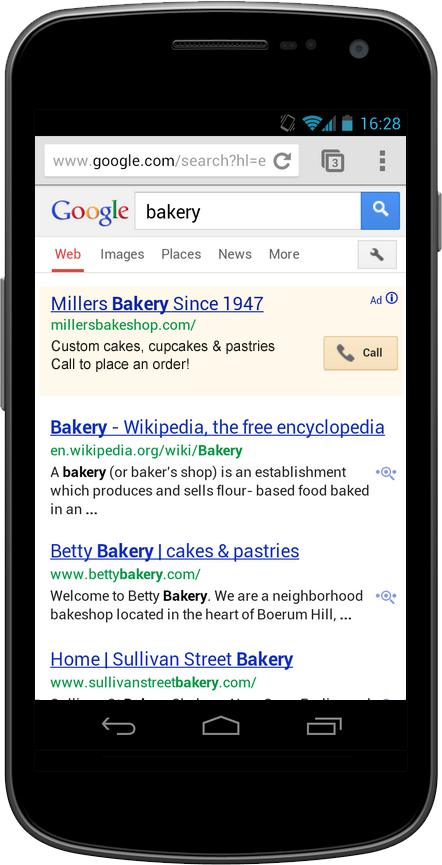
Mobile technology is making it easier than ever for people to research products and connect with businesses while they’re on the go. But we all know that sometimes it helps to speak to a real person before making a purchase decision. In fact, research shows that 52% of smartphone users have called a business after looking for local information on their mobile devices. Calls are key in helping consumers connect with businesses in the digital age, so incorporating a click-to-call strategy on mobile is crucial for any company that does business over the phone.

Companies big and small have put click-to-call functionality front and center in their mobile ads to reach customers on the go, and have seen impressive results. For instance, Comcast incorporated click-to-call ads into their mobile strategy, and now find mobile drives more than 10% of online sales. Esurance also reduced their cost per acquisition by 20-30% compared to other channels by using Google mobile ads with click-to-call. With more than 20 million calls made through Google click-to-call ads each month, it’s clear that mobile works when driving calls to businesses. In fact, our studies have shown that adding Call Extensions to mobile ad campaigns have improved advertisers’ average click-through rates by about 6-8%.

But as any business knows, getting customers to call is only half the battle. That’s why we’ve invested in features like Google call forwarding numbers, which show detailed reporting on calls generated from your ad campaign such as call start and end time, duration and caller area code. Having this valuable information can help advertisers understand how effective their ad campaigns are at driving calls as well as the quality of those calls. Advertisers using Google call forwarding numbers see calls last over six minutes on average.


We’re working hard to continually improve the click-to-call experience for advertisers and consumers. Here are a few of the things that our team has recently been hard at work on:

  • Click-to-call button - We recently introduced a new click-to-call button for ads leveraging Call Extensions, which people can easily tap to call businesses. Early results indicate that this new design positively impacts advertiser click-through rates and call volume.
  • Expanding availability of Google call forwarding numbers - We’re also focused on bringing Google call forwarding numbers to more advertisers so they can better measure the full value that mobile is driving through calls. Already available in US and UK, we recently expanded availability to Germany and plan to expand availability to additional countries in the coming months.
  • Call Extensions for in-app ads - We also recently introduced Call Extensions for ads showing in apps on the Google Display Network. Now in addition to click-to-call ads across the mobile web, advertisers can also drive calls from ads in more than 300,000 mobile apps.

New click-to-call button
If you haven’t yet tried Call Extensions in your mobile campaigns, you can find instructions for enabling in our Help Center. We will also be hosting a webinar on December 5th focused on tracking call performance in your AdWords campaigns. To register for this webinar, click here.

Posted by Anurag Agrawal, Product Manager, Mobile Search Ads
Read More
Posted in | No comments

Wednesday, 28 November 2012

A free month of advertising from AdWords Express

Posted on 09:05 by Unknown

The holidays are a busy time for everyone, and small businesses are certainly no exception. To help businesses reach new customers this season and keep the holiday spirit rolling into 2013, we have a special offer for new AdWords Express users in the U.S. If you sign up for AdWords Express before December 16, 2012, you’ll receive a free advertising credit in January worth what you spend between now and the end of this year.*

Since AdWords Express launched in July 2011 in the United States, we’ve seen businesses from toy stores to tree farms use AdWords Express to get their businesses discovered online. After 16 busy months, AdWords Express has expanded its borders to 12 additional countries and 9 languages, so that gift shops in Germany, heating contractors in the U.K., and surf shops in Australia can get on the map in front of potential customers in time for the holiday season.

Watch these businesses talk about how they use AdWords Express to maximize sales in the busy season:


Remember, the sooner you start advertising online, the more holiday customers you can reach and the more free advertising credit you can earn, so visit google.com/adwords/express today.

Happy holidays from the AdWords Express team!


Posted by Enrique Muñoz Torres, Sr. Product Manager, AdWords Express

*Terms and Conditions
Read More
Posted in AdWords Express | No comments

Tuesday, 27 November 2012

Google Tag Manager: Video and Q&A

Posted on 15:02 by Unknown
Have you ever struggled with implementing new marketing and measurement tools on your website? For many people, deploying data collection “tags” (like conversion tracking, remarketing, audience reporting and analytics) can take weeks or months. Worse, the tag implementation is often incorrect, meaning you’re missing out on valuable information about your site and its users.

It doesn’t need to be difficult. We recently held a webinar to introduce users to Google Tag Manager, a free tool that helps marketers and IT departments manage their marketing and measurement tags quickly and easily. Watch the video here to learn more about:
  • Overall benefits and features of using Google Tag Manager
  • A quick demonstration of how to deploy a new tracking tag
  • Tips for getting your company started with Google Tag Manager


In addition to this webinar, we’ll be hosting a technical webinar in January to help new users through the nuts and bolts of installing Google Tag Manager (with lots of concrete examples). Stay tuned -- we’ll share registration information in a future blog post, or you can check back on the Learn with Google webinar site.

Read on for responses to some of the top questions we received during the webinar.

Questions and Answers

Where can I find out more about the core concepts described in the webinar?
To learn more about the Google Tag Manager management interface, please visit our Help Center -- you may want to start with our Before you Begin article. There you can find more information about key concepts like Tags, Rules, and Macros. For developers interested in how to implement Google Tag Manager, please visit our developer documentation. Or if you’d like help with implementation, you can contact one of our Partners. You can also ask questions (and find responses to questions from others) on the Google Tag Manager product forum.

What happens to historical data if we move to Google Tag Manager?
All of your historical data should be preserved when you move to Google Tag Manager. Google Tag Manager only changes the way that tags are deployed and managed on your site, it does not change the way data is collected.

How would you migrate a tag?
Follow these steps to migrate tags -- whether it’s a single tag or all the tags on your site. If you’re just getting started, take a look at our Before you Begin article.
  • Create a Google Tag Manager Account and a Container associated with that account.
  • Install that Container code snippet on every page of your website (so that it appears immediately after the opening <body> tag). The container should be empty.
  • Map your site - thinking about what data you want to collect, what events you want to track, and which tags you want to use to track that data. You should think about where your current tags are implemented, but now is a great time to rethink your overall data collection goals and start fresh.
  • (Optional) If you would like to make use of the Data Layer functionality, create a data layer on the pages where you wish to pass information or fire tags
  • Create Tags, Rules and Macros within the Google Tag Manager interface according to the map you just created. Make sure to apply the correct Rules to your Tags to make sure they fire in the right place.
  • Test the changes you’ve made in Google Tag Manager using debug and preview mode.
  • Then push a version of your site live that has removed the hard-coded tags from within the page. At this time, also Publish your changes using the Publishing feature of Google Tag Manager, which pushes the changes live to the site.
For more precise details on these steps, read our developer documents about migration.

Can you add tags to events or buttons?
Definitely! In order to use Google Tag Manager to fire tags on events and buttons, follow these steps (for more detail, read our developer document on event handlers):
  • On your page, proactively add the dataLayer.push({ ‘event’: ‘myEventName’}) to the event handlers for all events and buttons you might want to track.
  • Create a new rule where “event equals myEventName”.
  • Associate this rule with any tag you’d like to fire when the specified event happens.
Can hard-coded tags and tag manager co-exist? Do I have to remove my other tracking tags?
We strongly recommend that you completely migrate all your tags, so you can take advantage of the benefits of managing and updating those tags within Google Tag Manager. However, if a full migration seems too hard, you can use Google Tag Manager in parallel with hard-coded tags. Some of our users use Google Tag Manager to only manage adding new tags.

If you choose to do a partial migration to Google Tag Manager, you need to be very careful to make sure you don’t accidentally start double-counting your tags. If you decided to deploy a tag via Google Tag Manager, make sure that you don’t have a version of the same tag firing on the same page.

Can you build your own custom tag templates? And how do I become a recognized Tag Vendor within Google Tag Manager?
Custom Tag templates within Google Tag Manager allow you to copy/paste any HTML or Image tags directly into Google Tag Manager and fire it based on your predefined rules and macros. To turn it into a template, use the {{macro_name}} syntax to populate the tag code with dynamic values. We will also do a syntax check to ensure that when you copy your 3rd party tag, it will fire as intended.

If you’re interested in having your tag added to the list of predefined templates, apply to become a Tag Vendor within Google Tag Manager by completing this interest form.

How does this work with Google Analytics? How do you do things like track pageview and track event within Google Analytics?
Google Tag Manager is a convenient way to correctly deploy Google Analytics across your site. To use Google Analytics within Google Tag Manager, simply create a Tag with the Google Analytics tag template. You can select the “Track Type” as either a pageview, an event, or a transaction.

Make sure you have some version of the Google Analytics tag firing across all pages on your site. A good way to do this would be to have a basic tag firing on all pages, but blocking on pages where your more customized tags are firing (like the thank you page where you’d be firing a specialized transaction tag type).

Can the Google Tag Manager snippet be placed in <head>? How about in my footer?
The recommended best practice is to have the Google Tag Manager snippet at the top of the <body> to maximize data collection, but some clients may find it easier to implement the Container snippet elsewhere in the in the page, like the footer.

Do not place the Google Tag Manager snippet in <head> (for the IT folks: this is because there is an iframe in the <noscript> case, which can have unpredictable results in some browsers).

No matter where you install the container snippet, you will need to make sure that this snippet of code is on every page of their site. Google Tag Manager will still work if you only deploy it on part of your site, but Google Tag Manager’s rule based system will only work on pages where the snippet is deployed. For more details, read our developer documents.

Does Google Tag Manager replace Doubleclick Floodlight?
No, Google Tag Manager does not replace Floodlight -- they are complementary. Floodlight is a conversion pixel for DoubleClick products (Floodlight tags can now be deployed within Google Tag Manager), and Google Tag Manager is a tag management system or “container tag” for multiple tagging technologies. Floodlight has previously been used by some users as a container tag as well, but moving forward, Google Tag Manager is a way to deploy all tracking technology.

You also have the ability to pass custom floodlight variables through Google Tag Manager into Floodlight, through the Data Layer. For more information, please review the material in the Developers Guide.

We hope this webinar and this blog post will help you as you get started with Google Tag Manager, and we look forward to seeing you at our technical webinar in January. (Registration details coming soon).

Cross posted from the Google Analytics blog, originally posted by Laura Holmes, Product Manager, Google Tag Manager
Read More
Posted in Google Analytics, Reporting and Analytics | No comments

Monday, 19 November 2012

Helping you be more productive with the AdWords interface

Posted on 13:59 by Unknown
We know for many of you, the holiday season is the busiest and most important time of the year. So, there's no better time to bring you some improvements in the AdWords interface that save you time and help you manage your campaigns more effectively. 

What’s new

1. Keyword column in search terms report

Have you ever looked at your search terms report and wondered what search term the query was matched out from? Now, we’ve added a "Keyword" column so you can see the precise keyword that matched someone's search term and triggered your ad. Based on the fit you see between the matched keyword and the search term, you might choose to make adjustments to your keyword lists, add negatives to campaigns or ad groups,  adjust your ads or bids, or adjust your landing pages.

To see this new column in AdWords, first open a search terms report. Next, click the “Columns” drop-down button and click "Customize columns." Now, as you see in the image below with red boxes, click “Attributes,” and finally click “Add.”


2. Campaign diagnostics
When you’re busy jumping from task to task, wouldn’t it be nice to know there’s a diagnostic system running in AdWords to alert you of potential errors or conflicts in your campaign? Over the next couple weeks, that’s exactly what we’ll be rolling out. 

Running in the background, our systems will look for potential errors or conflicts in your account. If a potential problem is diagnosed, you’ll see a polite alert so you can address it immediately. For example, if you add a negative keyword that blocks other keywords in your campaign, it could be helpful to know so you don’t inadvertently block yourself from appearing on searches that you value highly. Over time, with your feedback, we’ll refine these diagnostics and add more.

Other recent improvements

Be sure you’re also taking advantage of other recent innovations in the AdWords interface to help you be more productive and make better decisions with your campaigns. Here’s a recap with links to learn more and get started with each one.

  • Faster editing across your account. Need to adjust all your bids by 10%? Or find and replace a word in all your ads? Making changes like these across your entire account just got a lot faster and easier.

  • Shared campaign budgets. Now, a budget can be shared by multiple AdWords campaigns in the same account. Shared budgets can simplify how you manage spending for multiple AdWords campaigns with common marketing goals. And it can potentially improve your overall account performance.

  • Impression share reporting improvements. We’ve recently added distinct search and display columns for impression share data. There’s now “hour of day” segmentation so that you can evaluate how your ad coverage varies by the hour. And with filters, charts, and automated rules support, you’ll be more productive analyzing and optimizing your campaigns using impression share data than ever.  

  • Email-only alerts with automated rules. Automated rules let you make changes in your account automatically based on requirements that you specify. Now, automated rules can also be used to simply send an e-mail alert. If you like the idea of knowing when certain conditions occur within your account but you aren’t comfortable with certain changes being made in response automatically, then you’ll want to check this out.

  • Program your campaigns with AdWords scripts. If you’re an AdWords power user and want to take the level of automation, integration, or custom reporting up a notch, now all you’ll need is some Javascript knowledge. Updating your ads in real-time with new numeric data from a pricing database, adjusting bids and keywords based on your inventory data, or pulling key data into a custom dashboard are just a few potential uses.

There’s a passionate team at Google dedicated to improving your experience and productivity with our AdWords campaign management tools. So if you’ve got feedback or a great idea for a new feature (or get stuck and need help!), please contact us.

Posted by Paul Feng, Director, AdWords Product Management

Read More
Posted in | No comments
Newer Posts Older Posts Home
Subscribe to: Comments (Atom)

Popular Posts

  • Understanding the full value of mobile: adidas and RadioShack drive in-store traffic with mobile
    We live in a multi-screen world where people are constantly connected and moving seamlessly across devices. Not only do mobile devices keep ...
  • +1 around the world
    A few months ago we released the +1 button on English search ads and organic search results on google.com. More recently, we’ve made the +1...
  • Showing the display URL domain in the headline for select ads on Google
    In an AdWords ad, the display URL may be last, but it’s certainly not least. In fact, the display URL can be an important deciding factor in...
  • AdWords Hangout-on-air: Boosting your AdWords campaign with Dynamic Search Ads
    Dynamic Search Ads are an efficient new way to target relevant searches with ads generated directly from your website. They generate increm...
  • Measure Your Success: Call Reporting Now Available in AdWords Express
    How did you find us? There's a good reason so many business surveys include this question: understanding how people connect with your ...
  • Because Data Beats Opinion: Introducing Think Insights with Google
    It’s one of our company’s guiding principles that data beats opinion. And as such, we’ve put a lot of effort into asking some interesting qu...
  • How Google+ has helped Cadbury connect with over 1.2 million people
    Cadbury has become the European brand with the largest number of followers on Google+, currently at 1.2 million . Their Google+ success is h...
  • Impression Share Updates Rolling out Globally
    Starting today, we will begin rolling out updates to your Impression Share metrics , which include new ad group-level impression share metri...
  • Google Partners Goes Global: Empowering agencies with new leads, new tools, new opportunities
    Google is committed to making the web work for you. That’s why we’re proud to announce the worldwide launch of Google Partners – a platform...
  • Perspective on Dynamic Search Ads - Guest Q & A with RKG
    Since introducing Dynamic Search Ads in beta in October, we’ve seen questions from around the web asking about real-world performance and r...

Categories

  • #decemberadventure
  • +1
  • account management
  • Account Security
  • Ad Approvals
  • Ad Formats
  • Ad Innovations
  • Ad Rank
  • ad rotation
  • ad traffic quality
  • Ads Preferences Manager
  • Ads quality
  • ads showcase
  • AdSense
  • Advertising Week
  • adwords
  • AdWords Community
  • AdWords Editor
  • AdWords Examples
  • adwords experts
  • AdWords Express
  • AdWords for video
  • AdWords Help Center
  • AdWords Online Classroom
  • adwords support
  • Agency Blog
  • android
  • Announcements
  • apps
  • Audience Targeting
  • Automated Rules
  • Automotive
  • Best practices
  • bid manager
  • Bidding
  • Billing
  • Brand
  • Browsers
  • Budgets
  • Bulk Actions
  • Campaign management
  • Campaign Targeting
  • Case studies
  • Change log
  • Channel Intelligence
  • Chris Brogan
  • Conversion Optimizer
  • Conversion Tracking
  • Conversions
  • Creative Sandbox
  • Destination URL
  • Display
  • Display Ads
  • Display Network
  • Display URL
  • DoubleClick for Advertisers
  • doubleclick search
  • Dynamic search ads
  • Enabling better decisions
  • enhanced campaigns
  • Enhanced CPC
  • Events
  • Extensions
  • floodlight
  • Geo-targeting
  • GoMo
  • Google AdWords Certification Program
  • Google Analytics
  • Google Display Network
  • Google Merchant Center
  • google play
  • Google Shopping
  • Google Trends
  • google+
  • Google+ Pages
  • Hangout on Air
  • Help Desk Hangouts
  • Help Forum
  • html5
  • Impression Share
  • Insights
  • Interest Category Targeting
  • Keywords
  • Landing Page Quality
  • Learn with Google
  • Learning resources
  • local
  • location
  • Location Extensions
  • Location targeting
  • maps
  • Measurement
  • measuremore
  • Mobile
  • mobile sites
  • Multi-Screen
  • My Business Story
  • My Client Center
  • New Ad Formats
  • New features
  • New Interface
  • offer extensions
  • offline results
  • Opportunities tab
  • Optimization
  • pages for businesses
  • Paused Ads
  • placement exclusion lists
  • Policy
  • Product Ads
  • Product Listing Ads
  • Promoted Videos
  • Quality Score
  • Remarketing
  • Reporting
  • Reporting and Analytics
  • research
  • Search Ads
  • Search Engine Strategies conference
  • Search Funnels
  • Seasonal
  • Security
  • shared library
  • sitelinks
  • Smart Phones
  • SMX East
  • Social
  • Success Stories
  • System updates
  • Tablet
  • Targeting
  • Testing opportunities
  • Think Insights
  • Think Marketing
  • Think With Google
  • Tips
  • Tools
  • Top Contributors
  • top of page bid estimates
  • Tracking
  • TrueView
  • TV Ads
  • Updates
  • User Experience
  • ValueTrack
  • Webinars
  • YouTube

Blog Archive

  • ►  2013 (162)
    • ►  December (5)
    • ►  November (15)
    • ►  October (11)
    • ►  September (7)
    • ►  August (12)
    • ►  July (11)
    • ►  June (20)
    • ►  May (29)
    • ►  April (11)
    • ►  March (16)
    • ►  February (17)
    • ►  January (8)
  • ▼  2012 (182)
    • ▼  December (10)
      • Announcing the 2012 Top Contributor badge recipients
      • More investments for powerful, flexible, and fast ...
      • AdWords Express holiday offer extended for a limit...
      • New column makes keyword management easier
      • Modcloth and Inflection Drive Performance with Nex...
      • Education and training opportunities this week
      • Google Shopping: Promotional Credit and Update to ...
      • How an AdWords expert uses Google Analytics data
      • Build your digital brand with Google+ Webinar
      • Announcing a new Google Ads Hangout on Air series ...
    • ►  November (18)
      • Dialing up on click-to-call
      • A free month of advertising from AdWords Express
      • Google Tag Manager: Video and Q&A
      • Helping you be more productive with the AdWords in...
    • ►  October (18)
    • ►  September (20)
    • ►  August (13)
    • ►  July (10)
    • ►  June (25)
    • ►  May (17)
    • ►  April (17)
    • ►  March (17)
    • ►  February (11)
    • ►  January (6)
  • ►  2011 (156)
    • ►  December (11)
    • ►  November (18)
    • ►  October (13)
    • ►  September (8)
    • ►  August (10)
    • ►  July (10)
    • ►  June (20)
    • ►  May (17)
    • ►  April (15)
    • ►  March (17)
    • ►  February (16)
    • ►  January (1)
Powered by Blogger.

About Me

Unknown
View my complete profile